

Open enrollment
Decode your benefits. Choose with confidence. Benefits Decoder is the math from your own benefits documents and situation, organized: which health plan costs you least for the way you actually use care. We're here to help you understand your benefits so you can make informed decisions. Compare my plans
You did what you were supposed to. You picked a plan, you paid the premium, you handed over the copay at the desk. Weeks later a bill arrives, and you still don’t know what your plan actually covers or what that visit was going to cost. That is not a failure of attention. These documents are genuinely hard to read, and nobody ever sits you down and explains them. Benefits Decoder exists to make them make sense.
The problem with benefits guides
Every fall you get a 40-page PDF, a deadline, and a decision that quietly costs (or saves) you $500–$2,000 a year. Most people pick whatever they picked last year. The decoder reads the whole guide, runs the math for your situation, and tells you plainly which plan wins, and why.
Watch the answer flip
This is the free true-cost calculator, running. As the year you expect gets more expensive, the plan that costs you least changes. The point where it changes is what your enrollment decision actually turns on, and your benefits guide never tells you where it is.
Real math, not a mockup: two sample plans (PPO $480/mo with a $1,500 deductible; HDHP $330/mo with a $4,500 deductible and $500 of employer HSA money). Put your own two plans in.
How it works
Who you're covering, your age bracket, how much care you expect, and whether you could set money aside for medical costs.
Upload the PDF, paste the text, or type the numbers in yourself with field-by-field help.
Every plan in your guide compared for one price: the one that costs you least, the math behind it, your 401(k) match decoded, and the benefits everyone forgets they have.
What's in your report
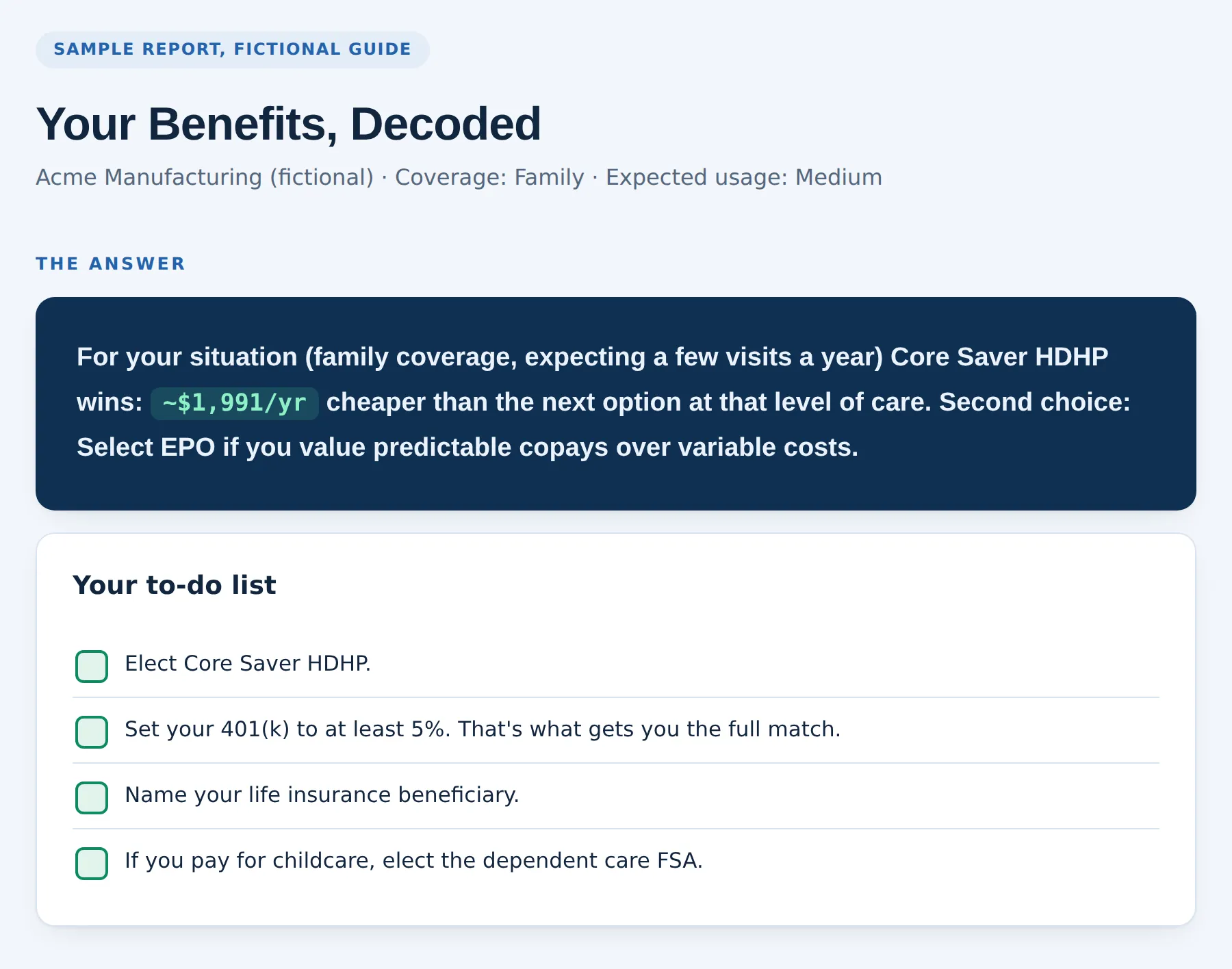
One plan, named, with the annual dollar gap to the runner-up, or an honest "it's a toss-up" when it truly is.
Premiums plus expected medical bills, minus employer HSA money, under low, medium, and heavy usage.
Premiums, deductibles, out-of-pocket maximums, and copays, translated into plain English.
A doctor visit, a specialist visit, and an ER trip: what each plan would actually make you pay, and why.
The exact contribution percentage that captures every match dollar, plus vesting in one sentence.
Free life insurance, disability coverage, FSA traps, wellness money, dental, vision, ranked by dollar impact, with a two-minute to-do list.
A complete report, built from a fictional company's benefits guide. Same structure, same math, same plain English you get for your own. Read the whole thing and then decide.
Tools and resources


Every open enrollment, the same question lands in HR's inbox fifty ways: "which plan should I pick?" You are not allowed to answer it. We are.
Benefits Decoder is the math from your own benefits documents and situation, organized. It reads your employer’s benefits guide and shows you, in plain English, which health plan costs you least for the way you actually use care.
No. Benefits Decoder is anonymous by design: no accounts, no names, and your guide is read once and never stored. Your report lives in your own browser rather than on our servers.
Two places: your own benefits guide, and published figures from primary sources including the IRS, CMS and the Department of Labor.
A few minutes. You answer some questions about the care you expect, hand over the guide, and the report prices every plan side by side.
No. It's the math from your own benefits documents, organized and explained. Every number traces to your guide or a stated assumption, and the official plan documents always win. For big tax or legal decisions, talk to a qualified professional.
Enrollment guides, benefits summaries, and SBC documents, as a PDF upload or pasted text. Scanned, image-only PDFs can't be read (yet); for those, paste from your benefits portal or type the numbers in with our guided form.
Some enrollment brochures name the plans but hide the numbers. If yours does, we tell you exactly what to request from HR (the SBC), and your unlock covers the re-run. You're never charged twice.
Every plan in your guide, compared — and enough decodes for a real household decision: your guide, your spouse's guide, and re-runs when HR sends the better document. One price, no subscription, no per-plan upcharges.
A more informed enrollment
Compare your plan options with your priorities, expected care, and complete financial picture in view.